Last week, we traced two early images of law through Genesis and the Oresteia: law as command, and law as public judgment. This week, the bridge from myth to modern political theory takes the form of another extraordinary image—a giant made of people.
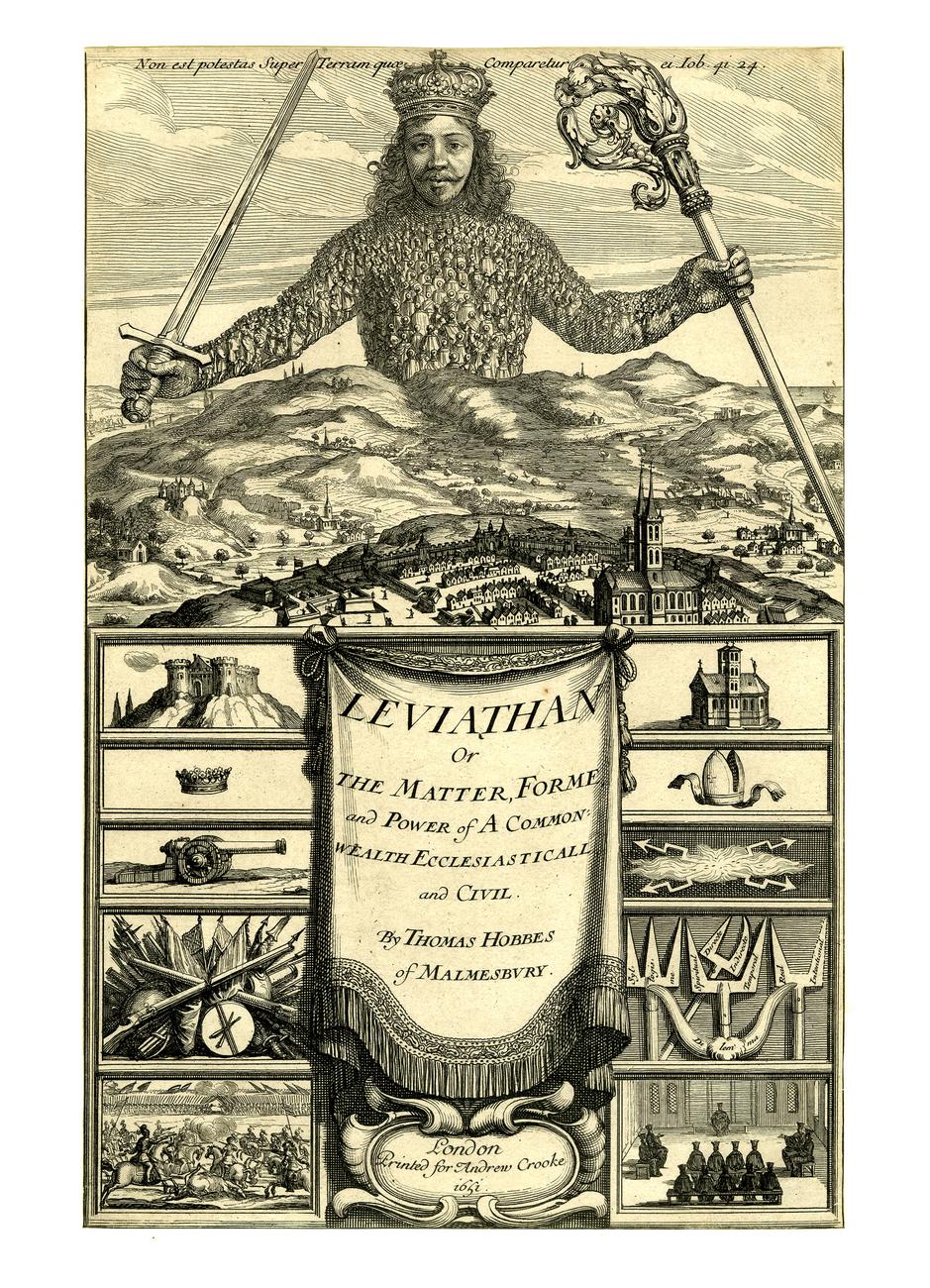
Look closely at the frontispiece of Thomas Hobbes’s Leviathan. Why is the sovereign enormous? Why do hundreds of people disappear into its body? To answer, we must begin where Hobbes began: with a world before any common power.
In Chapter 13, Hobbes asks us to imagine the “state of nature.” In this condition, human beings are equal—not in talent or strength, but in vulnerability. Even the strongest can be killed by the weakest, through secrecy or alliance. Once no one can trust anyone else, striking first begins to look rational. There can be no secure property, no lasting industry and no settled knowledge, because no one can be sure of keeping what they build. Human beings possess almost unlimited freedom, yet no enforceable rights and no justice: a “warre of every man against every man.”
How do they escape? By covenanting with one another. Each person agrees: “I authorise and give up my right of governing my selfe.” That transferred authority gathers into a sovereign—the Leviathan—strong enough to enforce promises, punish defection and keep the peace. This is why the giant is made from its subjects. The sword and crozier in its hands signal temporal and spiritual authority; the image itself argues that order begins when many wills are made into one.
Hobbes did not imagine this fear in a vacuum. He lived through the English Civil War, when political and religious conflict turned neighbour against neighbour. His answer to chaos was not a gentler humanity, but a power strong enough to hold chaos back.
Yet every powerful image casts a shadow. To illustrate life without government, Hobbes pointed to the “savage people in many places of America,” claiming that they lived without government in a “brutish manner.” Indigenous societies were turned into evidence of Europe’s imagined past. Their own laws, institutions and relationships to land disappeared from view because they did not resemble Europe’s.
That way of seeing travelled. When the British arrived in Australia in 1788, they did not encounter an empty continent. They encountered societies whose laws, customs and connection to Country they failed to recognise. No European roads? Then no civilisation. No familiar courts, schools or churches? Then no law or order. No state in a form Britain recognised? Then, in the colonial imagination, no settled law governing the land.
Difference was recast as absence. That failure of recognition hardened into the fiction of terra nullius and helped justify dispossession. More than two centuries later, in Mabo v Queensland (No 2), the High Court rejected that fiction as a basis for denying pre-existing rights and recognised that native title could survive under traditional laws and customs.
Hobbes did not invent terra nullius, and he was not writing about Australia. But his contrast between “nature” and “civilisation” supplied a language that colonialism could use: Europe cast itself as Leviathan, and Indigenous societies as the chaos that came before it.
Do myths, paintings and literature tell stories out of thin air? Hardly. They are workshops in which law learns what order looks like—and, sometimes, whom it refuses to see. From Genesis to Leviathan, the thread between cultural imagination and legal institutions has never been broken. In the weeks ahead, we will keep following that thread, and invite you to notice where it appears in everyday life.
Sources and further reading
- Desmond Manderson, “The Law of the Image and the Image of the Law: Colonial Representations of the Rule of Law” (2012–2013) 57 New York Law School Law Review 153–168.
- Mabo v Queensland (No 2) [1992] HCA 23; (1992) 175 CLR 1.
- Thomas Hobbes, Leviathan (1651), Chapters 13 and 17.
- Abraham Bosse, title-page to Thomas Hobbes’s Leviathan (1651), British Museum, museum no. 1858,0417.283, image asset 82477001.
Developed from the author’s learning in LAWS6249 Legal Theory at ANU Law School.
This post provides general legal education and cultural commentary. It is not legal advice.